
Why Real-World Fitness Games Are the Future of Training
The Next Revolution: Moving Beyond the Screen
Introduction
Real-World Fitness Games are the future of training.
For years, fitness apps focused on screens — tracking data, showing charts, and sending reminders. But the future of fitness is happening outside the screen — in the real world.
With GPS, sensors, and smart devices, training is no longer just about reps; it’s about location, teamwork, and experience.
Push Up Legends pushups app represents this next generation: a Real-World Fitness Game where every push-up counts toward conquering territory, defending your city, and building real strength — together.
The Rise of Real-World Fitness
Real-World Fitness Games Are the Future of Training
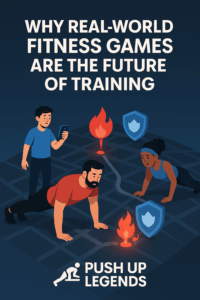
Games like Pokémon GO proved that technology can motivate people to move. But where those games focus on collecting, Real-World Fitness Games focus on performance.
Instead of virtual creatures, you capture real locations through physical effort.
You train, explore, and connect — turning cities into playgrounds and workouts into shared adventures.
📚 Reference:
Althoff, T., et al. (2016). Large-scale physical activity data reveal worldwide activity inequality. Nature, 547(7663), 336–339.
🔗 https://www.nature.com/articles/nature23018
The Science Behind Gamification
Real-World Fitness Games Are the Future of Training
Gamification activates dopaminergic reward pathways in the brain — the same circuits triggered by progress, competition, and recognition.
Leaderboards, teams, and achievements create ongoing motivation loops that sustain engagement far beyond willpower alone.
📚 Reference:
Hamari, J., & Koivisto, J. (2015). Why do people use gamification services? International Journal of Information Management, 35(4), 419–431.
🔗 https://www.sciencedirect.com/science/article/pii/S0268401215000241
From Virtual to Real Strength
Real-World Fitness Games Are the Future of Training
What makes Push Up Legends unique is that its gameplay doesn’t just exist on a map — it translates into real-world fitness outcomes.
Every push-up is tracked using Apple’s TrueDepth camera, ensuring that each rep is real.
Your GPS location determines your Control Points, so where you train becomes part of the game.
Your muscles, heart, and focus become your controllers.
This is the merging of exercise physiology and location-based gaming — real-world effort, real-world impact.
📚 Reference:
Staiano, A.E., & Calvert, S.L. (2011). Exergames for physical education courses: Physical, social, and psychological benefits. Child Development Perspectives, 5(2), 93–98.
🔗 https://srcd.onlinelibrary.wiley.com/doi/full/10.1111/j.1750-8606.2011.00162.x
Community, Competition, and Collaboration
Every captured Control Point in Push Up Legends is a mark of community
Social fitness consistently increases adherence — people stick with routines when they feel connected to others who share their goals.
Teams, friendly rivalry, and shared challenges give meaning to movement.
Every captured Control Point in Push Up Legends is a mark of community — strength multiplied through cooperation.
📚 Reference:
Beauchamp, M.R., Eys, M.A., & Morton, K.L. (2017). Group dynamics in exercise and sport psychology: Contemporary themes. Routledge.
🔗 https://pubmed.ncbi.nlm.nih.gov/28813332/
Their research highlights that group cohesion and social identity are key predictors of sustained participation and enjoyment in physical activity. In other words, people don’t just train for fitness — they train for belonging.
The Takeaway
The future of fitness isn’t confined to screens — it’s in the streets, parks, and gyms where real movement happens. Real-World Fitness Games are the future of training.
Read also this blog about ”Where Pushups Meets Adventure”.
Push Up Legends combines the science of gamification with the art of training — turning motivation into movement and effort into adventure.
It’s not just a workout. It’s a world to conquer.
#PushUpLegends
Disclaimer
This article is for educational purposes only and does not constitute medical or performance advice.