
Boredom, Youth & Movement
How Real-World Fitness Games Give Young People Purpose, Motivation, and Daily Structure
Boredom is one of the most underestimated challenges facing young people today.
In a world of endless scrolling, short-form content, and passive entertainment, many teenagers and young adults experience days that lack structure, purpose, and meaningful physical activity. While boredom may seem harmless, research shows it is closely linked to decreased mental wellbeing, unhealthy behaviors, and reduced motivation to move.
Real-world fitness apps that combine movement, goals, and play offer a powerful solution. By turning physical activity into a daily mission instead of a chore, they help young people reconnect with their bodies, their environment, and a sense of progress. Download the Push Up Legends app in the App Store and start today!
Why Boredom Is a Serious Health Issue for Young People
Studies consistently show that chronic boredom in adolescents is associated with:
- Higher levels of stress, anxiety, and depressive symptoms
- Increased screen time and sedentary behavior
- Lower intrinsic motivation for physical activity
- Greater risk of unhealthy habits such as substance use
A large-scale review published in Frontiers in Psychology highlights boredom as a predictor of risk-taking behavior and reduced psychological wellbeing in adolescents.
https://www.frontiersin.org/articles/10.3389/fpsyg.2020.00296/full
When days lack structure or challenge, young people often default to passive consumption. This creates a feedback loop: less movement leads to lower energy, lower mood, and even less motivation to act.
Movement as a Daily Anchor
How Real-World Fitness Games Give Young People Purpose, Motivation, and Daily Structure
Physical activity is one of the most effective, evidence-based ways to combat boredom and improve mental health in youth.
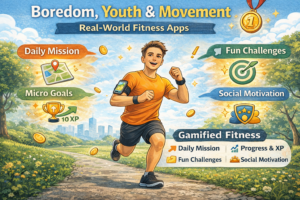
Boredom Youth & Movement – How Real-World Fitness Games Give Young People Purpose, Motivation, and Daily Structure
Research published in The Lancet Psychiatry shows that regular physical activity is strongly associated with lower levels of depression and improved mood across all age groups, with especially strong effects in adolescents and young adults.
https://www.thelancet.com/journals/lanpsy/article/PIIS2215-0366(18)30227-X/fulltext
However, traditional advice like “go to the gym” or “play sports” does not always resonate with younger generations. Many young people drop out of organized sports due to pressure, comparison, or lack of enjoyment.
This is where real-world fitness games change the equation.
From Workout to Mission: Why Gamification Works
Boredom, Youth & Movement
Gamification introduces clear goals, feedback, and progression — all factors known to increase motivation.
According to Self-Determination Theory, motivation improves when three psychological needs are met:
- Autonomy (choice and control)
- Competence (visible progress)
- Relatedness (connection with others)
Gamified fitness apps naturally support these needs by offering:
- Daily challenges instead of vague goals
- Progress tracking and achievements
- Social elements such as teams, leaderboards, or shared spaces
A study published in JMIR Serious Games found that gamified physical activity interventions significantly increase engagement and adherence among young users compared to non-gamified programs.
https://games.jmir.org/2017/2/e7/
Real-World Fitness Games Create Purpose Beyond the Screen
Unlike traditional fitness apps, real-world fitness games extend activity into the physical environment.
By linking movement to real locations, visible progress, and shared challenges, these apps turn neighborhoods, parks, and streets into interactive spaces. Instead of asking “What should I do today?”, users are given a clear daily objective:
- Capture a location
- Defend a zone
- Complete a challenge
- Contribute to a team goal
This structure transforms exercise into something young people want to do — not something they feel they should do.
Research on outdoor physical activity shows that combining movement with environmental engagement increases enjoyment and long-term adherence.
https://www.ncbi.nlm.nih.gov/pmc/articles/PMC6064518/
Building Healthy Habits Through Daily Wins
Boredom, Youth & Movement
One of the biggest challenges for young people is consistency. Big goals can feel overwhelming, especially when motivation is low.
Micro-goals — such as short workouts, daily streaks, or quick challenges — have been shown to significantly improve habit formation.
A study in Behavior Research and Therapy highlights that small, repeatable actions are more effective for long-term behavior change than sporadic intense efforts.
https://www.sciencedirect.com/science/article/pii/S0005796717301444
Push-up-based challenges, short strength sessions, and daily progress tracking fit perfectly into this model. They provide:
- A sense of achievement every day
- Visible improvement over time
- Confidence through physical capability
More Than Fitness: Identity, Confidence, and Belonging
For many young people, boredom is tied to a lack of identity and purpose. Real-world fitness games, like our Pushups app for iPhone, help address this by allowing users to see themselves as:
- Active
- Capable
- Part of something bigger
Research in Sports Medicine shows that strength training improves self-esteem and body image in adolescents, even without aesthetic goals.
https://link.springer.com/article/10.1007/s40279-018-0946-1
When movement becomes part of identity rather than obligation, it supports long-term physical and mental health. Download our app!
Why This Matters Now
Boredom, Youth & Movement
Youth physical inactivity is rising globally. According to the World Health Organization, more than 80% of adolescents do not meet recommended physical activity levels.
https://www.who.int/news-room/fact-sheets/detail/physical-activity
Addressing boredom with engaging, accessible movement tools is not just a fitness issue — it’s a public health opportunity.
Conclusion: Turning Boredom Into Momentum
How Real-World Fitness Games Give Young People Purpose, Motivation, and Daily Structure
Boredom doesn’t mean young people lack motivation — it often means they lack meaningful challenges.
Real-world fitness apps that combine movement, structure, and play provide:
- A daily goal
- A reason to move
- A sense of progress
- Social connection
- Physical and mental benefits backed by science
By transforming workouts into real-world missions, these apps help young people replace passive time with purposeful action — one push-up, one challenge, one day at a time.
That is why we developed Push Up Legends and added Control Points. Read more about our real world fitness game.