
The Science of Push-Up Progression
How Muscles Adapt, Grow, and Get Stronger Over Time
Introduction
Every push-up you do is a signal to your body — a call to adapt, grow, and perform better next time. But behind that simple movement lies a complex process of neuromuscular coordination, muscle fiber recruitment, and recovery cycles. This is why we have written this article about the science of push-up progression.
Understanding the science behind progression helps you train smarter — not just harder — and make every rep count.
The Principle of Progressive Overload
The Science of Push-Up Progression
Your body only gets stronger when it’s challenged beyond its current capacity.
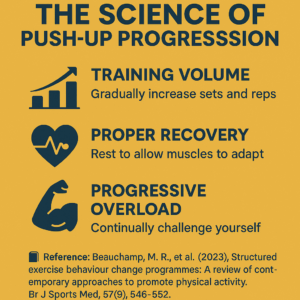
This is known as progressive overload — gradually increasing the stress placed on muscles to stimulate adaptation.
The Science of Push-Up Progression –
How Muscles Adapt, Grow, and Get Stronger Over Time
In push-ups, this can mean:
-
Doing more reps or sets
-
Reducing rest time
-
Changing hand position or tempo
-
Adding resistance (like weighted vests)
As your muscles adapt, the same workout becomes easier — so continuous progression keeps the growth going. Have you tried Grease the Groove?
📚 Reference: Schoenfeld, B.J. (2010). The mechanisms of muscle hypertrophy and their application to resistance training. J Strength Cond Res, 24(10), 2857–2872.
🔗 https://pubmed.ncbi.nlm.nih.gov/20847704/
Neural Adaptation: Strength Begins in the Brain
The Science of Push-Up Progression
In the early weeks of training, most of your strength gains come not from bigger muscles, but from improved neural efficiency.
Your brain learns to recruit motor units — groups of muscle fibers — more effectively and in sync.
That’s why beginners can double their push-up numbers within weeks without visible muscle growth. Your nervous system becomes better at firing the right muscles at the right time.
📚 Reference: Sale, D.G. (1988). Neural adaptation to resistance training. Med Sci Sports Exerc, 20(5 Suppl), S135–S145.
🔗 https://pubmed.ncbi.nlm.nih.gov/3057313/
Muscle Growth: Microscopic Damage, Macroscopic Results
The Science of Push-Up Progression
Each push-up causes microtears in your muscle fibers. During rest, the body repairs and reinforces these fibers, making them thicker and stronger — a process known as hypertrophy.
Adequate sleep, protein, and hydration are essential for this rebuilding process. Without rest, the body stays in a breakdown phase, leading to fatigue instead of growth.
📚 Reference: Damas, F. et al. (2016). Resistance training-induced changes in integrated myofibrillar protein synthesis are related to hypertrophy only after attenuation of muscle damage. J Physiol, 594(18), 5209–5222.
🔗 https://pubmed.ncbi.nlm.nih.gov/27219125/
Why Push-Ups Are So Effective
Push-ups activate over 70% of your body’s musculature, combining strength, stability, and endurance.
Unlike isolated movements, they train the entire kinetic chain — from hands and chest to core and legs — improving coordination and real-world strength.
This makes push-ups a superior functional exercise that translates directly to daily life and athletic performance.
The Takeaway
The Science of Push-Up Progression
Progression isn’t just about doing more — it’s about doing better.
By balancing challenge and recovery, you build not only muscle, but also control, coordination, and confidence. Read our article about the benefits of supercompensation.
Your next rep isn’t just a number — it’s an adaptation in motion.
Train smart, stay consistent, and keep pushing forward.
#PushUpLegends
Disclaimer
This article is for educational purposes only and does not replace professional medical or fitness advice.